Showing posts with label art from waste. Show all posts

Friday, May 2, 2014

The Windpump that Teaches Us Innovation


Today was one of those days where innovation, creativeness and uniqueness were everywhere to be found, even in the living room. When looking around us, we can often find artwork everywhere. Nature is in itself an artwork, but there are also the manmade artworks. Some of these manmade artworks have a way to surprise people with how simple the idea is, how little things it takes to make and how impressive the outcome is.

Many people are creative, but many people just keep it to their own websites or homes. Yet there are those who take their talent to the streets. When driving around Johannesburg, we often find highly talented dancers, mime artists and others with rather unique talents. Innovative art can also be found in Hartebeespoort Dam, on the way there and within it at the well-visited Chameleon Village. And then.... there are those artists who dwell in the 'other' nearby towns - Parys, Sasolburg, Vaalpark and Vanderbijlpark. These towns hold unique places, events and artwork. It was in Vanderbijlpark that I found a specific little gem of inspiring innovation.

A particular man was selling a 'windpomp'; an object of admiration for several people who were taking it apart to see how he managed to create it. The main parts of the pump were simply crafted from a tin. The rest was skilfully done with strong, thick wire. The bird that is so happily sitting in front of the tap, waiting for its water, was craftily made from a fallen conifer cone (better known as a pine cone). This is an artwork that took a lot of skill and time, but little resources.


There are plenty of tins lying around and many of nature’s own little pieces, which make this a financially practical and environmentally friendly artwork. It's impossible not to have respect for the way struggling or less fortunate people can often come up with the most innovative and unique ideas. We can all learn from their resourcefulness and about how not to waste, rather using and re-using what is available to us at the time. They don’t run to the shops the moment they don’t have canvas, they create their own canvas with what they see around them.

Look for your next artwork around your house, around your street and in your dustbin. You might find your light-bulb moment in something as simple as a dirty tin and some wire. This can be considered as proof that you can never say you’re too poor to make art. Art is inventing, art is seeing potential even in unlikely places.


Further browsing - some more links for Art from Waste:


Tuesday, February 25, 2014

Too busy trying to be an artist, to be green too?

Have you been painting, drawing or photographing this month? Have you been creating land art? Have you been living a creative life? Or have you been wrapped up and distracted by life's little dramas?

As artists we don't necessarily get encouraged or motivated to do art by looming deadlines and bosses tracking our productivity, unless you work at a company, or do a lot of client-driven work - in which case, I'm not really talking to you at the moment. I'm talking to the full time artists, the starving artists, the supposedly self-sustaining artists. The artists who need to motivate themselves to do the work they need to, in order to further their careers, or put food on the table. I'm talking to an enormous amount of artists, who might really like to do more natural or environmentally conscious work, but they cope with the stresses and challenges of:

  • managing their own self-criticism or inner critic enough so that they could push through the resistance and fear of failure far enough to actually produce an artwork. 
  • finding inspiration, art materials and the energy to work hard, while being worried about their bank balance, the rent needing to be paid in 3 days, or even overcoming the emotional turmoil from the latest gallery owner rejection. 
  • finding a place to sell or show their work - too often with a lack of knowing where to go, how to approach a gallery, shop owner or agent.
  • coping with clients for commissions who do not value our creative work in the same way that they value the work of a doctor, lawyer or financial manager - undercutting our prices, resulting that we make very little money when considering the cost of our materials and the amount of time it may take to create the commissioned work

I could go on and grow the list further, but the point I'm trying to make is that I understand that there are many challenges that artists face daily. So expecting artists to change the way they create art in order for it to be safer and more respecting towards our environment is a bit much to ask, right? Wrong! I believe that we can overcome many of these challenges by changing the way we make art. 


"Ungrown Branches" by Kai Lossgott


Before I talk about these benefits, let me clarify what changes I am referring to:
  • instead of buying commercial acrylics and oil paints, you mix your own paints - buying and collecting pigments and binders. Yes, you'll need to research and experiment, using tested recipes and even finding your own, but this is all part of the process, which adds to the story behind your work.
Danelle Malan from Cotton Star, painting with ProNature Paints as part of Claire Homewood's Collage Mural Project

  • If you're a sculptor, you will experiment with different materials and methods that don't create hazardous waste or toxic fumes.

Sculptural work in wood, by Loni Dräger

  • If you create prints, you could try to find new substrates to print on - organic cotton, hemp, papyrus, handmade recycled paper, dried leaves stitched together, bamboo sheets, wood... use your creativity!
  • Try use things you would normally throw away - keeping them away from the landfill or the ocean. You'll save money by using an empty yoghurt container to wash your paintbrushes instead of buying a container. You'll save even more money by using 'trash' as materials, creating interesting sculptures, installation art, or mixed media works. The sky is the limit, we have so much free materials to our disposal (no pun intended)!

"Power", found Plastic and Electrical Cables, Simon Max Bannister 2012

  • Also think about ways that your art can contribute to your community - doing murals, mosaics with waste materials, or giving art classes to kids. Your art will expand much more than you realize when you start exploring and being open to new opportunities and ways of doing things.

Land Art in the Tankwa Karoo by Strijdom van der Merwe


In short, I'm asking you as an artist to explore, to find new ways, to create something unique. Not really much to ask for, if you consider that this exploration and learning is PART of your job as an artist!

Because you'd be doing things differently to other artists, some people may struggle to understand your art at first, but it definitely sets you apart from your competition. Tell people about the process, how much you're learning about art through your new focus or approach. They will be interested, many will love it, and many people will be inspired to make changes in the way they do things within their work or life too. And you do want your art to inspire others, or make them think differently, correct?

Installation view of "Cree Prophesy" by Stefanie Schoeman

As mentioned, you could be saving money by working more naturally - avoiding chemically laden products and materials. Some 'pure' materials are more expensive than their commercial, mass-produced counterparts, for sure. But the cost to your health and wellbeing cannot be measured. Using a citrus cleaner for your oilpaints instead of turpentine is a great way to make a small improvement in your art practice. The citrus cleaner is more expensive, but without even being conscious of it, you'll be saving on medical costs in the future. Here's an extract about long-term exposure to turpentine:
When inhaled, turpentine can irritate the eyes, nose, throat and lungs, and cause coughing, wheezing, shortness of breath and a sore throat. The vapors may also affect the brain or nervous system, and trigger headache, dizziness, confusion and nausea. Beyond inhalation, if turpentine is ingested or absorbed through the skin, it can cause gastrointestinal burning and pain, nausea, vomiting, and diarrhea. Repeated or long-term exposure may damage the kidneys, bladder and nervous system as well as trigger dermatitis and eczema. (Source)
If you feel that changing your materials and techniques in your art is too much of a challenge, there is another way that you can effect positive change or support our planet. By focusing, even if only for one series of work, or in some of your artworks, on environmental issues, conservation or a related topic. As artists we have a responsibility to make society more aware, more clued up about what is really happening in our world. If you are one of the artists who answers this call of duty, then environmental degradation and sustainable development gives you a lifetime of conceptual material to work from. 


One in a series of photographs by Dillon Marsh, documenting the sociable weavers nests in the Kalahari 

Further reading - check out:

Eco Friendly Art Brands and Materials on Fine Arts with Lori McNee


Monday, April 22, 2013

Hubcap Project

Guest Post by Viv King


The Landfillart Project is an artistic endeavor that tries to increase awareness of the amount of trash people generate.

The idea was thought up by Ken Marquis, a gallery owner and framer from Wilkes-Barre, Pennsylvania, who started a collection of old discarded hubcaps  and has spent the last three years convincing other artists from all the US states and 52 foreign countries to give old hubcaps the artistic treatment.
An article from the Huffington post tells Ken's story:
Then he (Ken Marquis) began prowling the Internet, emailing artists who caught his eye to gauge their interest. 
A typical reply, Marquis says, went something like this: "`You want me to find a hubcap in my own country and pay for that, and you want me to pay for (the materials to make) this piece of great art, and then you want me to ship it to you at my expense, and then you want me to gift it to you? Am I understanding you correctly? OK, yeah, I'm in.'"
"I've had that conversation hundreds of times," Marquis says. "Artists get it."

I was one of the artists Ken contacted and I gave him pretty much the same reply! I am an ardent supporter of recycling projects, alternative building methods,  and making use of local materials and found objects wherever possible to create works of Art.

I was born in the Eastern Cape in South Africa, which has a rich tradition of beadwork amongst the Xhosa nation, lead by the great statesman and much loved former President, Nelson Mandela.

Beads were initially used as trading in the early part of the 19th Century and have a special social and ritual significance, used for denoting gender, age and status of the wearer.

I managed to source an old VW hubcap from a second hand car dealer. No, I did not trawl the dumpsites looking for them as I knew I would not find any. Some poor soul from the townships would have got there before me and made a stove out of it or something, this being South Africa and poverty being a powerful motivator of ingenuity.


I arranged the beads in an Ndebele pattern. The Ndebele is one of the many  groupings of people in the broader Southern Africa. I liked the strong African design.

A single bead is a humble object of little significance. But when put together in numbers they make a powerful statement. Just as the small voices who are calling to save our planet from extinction, when added together become a powerful  force of change in government laws, and bring about the end of industrial pollution in the world.

Ken has collected over 1000 hubcabs. 250 of these have been selected as part of a travelling exhibition which begins its journey in a Museum in Pennsylvania and from there around the States and hopefully around the world.

I am pleased that my hubcap has been chosen, as it is a subject very close to my heart.

View other hubcaps submitted as part of the project: landfillart.org/category/gallery-of-metal-canvases

Saturday, March 9, 2013

GREEN EXPO participation callout


Invitation for artist applications, curator proposals & sponsorship/collaboration
GREEN EXPO Green Art 2013

In November 2012 eight invited artists exhibited art during the Green Expo at the Cape Town International Convention Centre (CTICC). This year we are working with the intention of having an art exhibition at the Sandton Convention Centre GREEN EXPO too - we invite proposals from curators based in Johannesburg. In addition to the artists being invited to participate in the Cape Town exhibition, we are doing a call for Western Cape artists whose work can be categorized as "green art" or environmental art. 

Interested artists (Western Cape): 
Please send examples of your work (photographs of maximum 1MB each), an artist statement/description of your work and motivation, and your biography or artist resumé. 
DEADLINE: 30 April 2013

Interested curators (Johannesburg): 
Please send your proposal (outlining the basic concept or theme, potential artists, and general provisional layout and/or installation of the exhibition) and CV. 
DEADLINE: 30 April 2013

Partnership, sponsorship and collaboration:
Anyone interested to get involved in another way, don't hesitate to contact us. We need sponsors to fund the exhibitions, and this is a great opportunity to show your commitment towards the arts as well as creativity that raises awareness around environmental issues. 

To read more about the 2012 exhibition, go to www.greenart.artlovenature.co.za. You can also read the Green Art Manifesto for the 2012 exhibition on Kai Lossgott's blog at http://kailossgott.blogspot.com/2012/11/a-green-art-manifesto.html.

For more information, or to apply, please contact Janet Botes at art@janetbotes.co.za

Tuesday, December 18, 2012

Telephone Cord Sheep


by Artist Jean Luc Cornec
Museum of Communications in Auckland, New Zealand

Thursday, November 29, 2012

Conversations about art, function and nature at the Green Expo

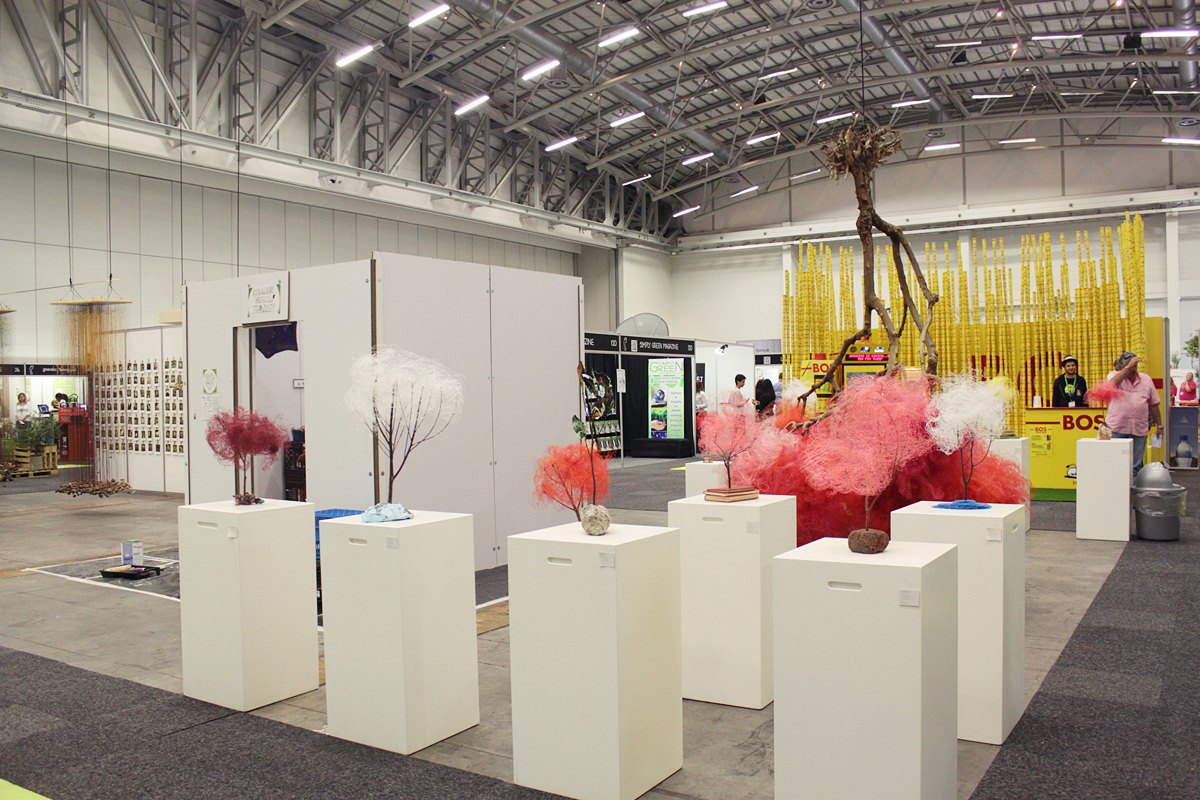
The Green Art exhibition is a new initiative of the Green Expo in collaboration with artists. Conceptualized and curated by visual artist Janet Botes, the exhibition aims to offer expo visitors a new experience in the form of artworks by different local artists. For the 2012 installment of the exhibition, entitled (eco)nversations, held at the Green Expo in assocation with National Geographic Channel 281, from 23-25 November, 8 artists exhibited work which ranged from painting, scupture, installation art and live, interactive art. The participating  artists for 2012 was: Simon Max Bannister, Janet Ranson, Stefanie Schoeman, Janet Botes, Danelle Malan, Nicolle Marais, Claire Homewood. Kai Lossgott wrote ‘A Green Manifesto’ in consultation with the curator and other participating artists.


Janet Ranson's Upset Tree and Avenue of Trees are dramatic assemblages of found timber and reclaimed nylon packaging material as a simple metaphor for humankind’s devastation of the natural order.


The Collage Mural Project is an interactive piece conceived and facilitated by Claire Homewood. Expo visitors were invited to create collages around the theme of (Eco)nversations. Artists used these collages as inspiration for collaborative mural painting


STEFANIE SCHOEMAN is particularly inspired by desert landscapes and, while spending the last year between the Karoo and Namibia, she has recognised these quiet open spaces as the current theme in her work.


Simon Max Bannister's Fragments of Paradise is a series of eroded plastic flotsam that were caught as samples in the middle of the Atlantic gyre


This exhibition was made possible by collaboration between the artists, the Green Expo organizers, the Shoprite Checkers Strokes of Genius art project, Pronature Paints and Xanita. The exhibition is hosted, sponsored and in partnership with the Green Expo in association with National Geographic Channel 281, organized by Three City Events. The exhibition aims to become an integral part of the Green Expo in the future of this annual event. 

www.greenart.artlovenature.co.za
www.thegreenexpo.co.za


Wednesday, April 27, 2011

Calling all fashion designers and textile fanatics!


Are you a fashion designer, installation artist or have the ability to sow?
CONTACT Nastasha Daniels to get involved with the next HumanEarth exhibition!

Please also contact if you have any old clothing, fabric, off-cuts, or anything else related that can be used and repurposed.

For more information on the HumanEarth exhibitions, have a look at www.humanearth.ecojunki.co.za


Julia Ramsey


The embrace by Boxi


This website is worth a look: seedandsew.com.

Thursday, February 3, 2011

Sustainble Art Workshop


GREENING YOUR ART
Basic Principles For Eco-Responsible Artmaking

7-8 April 2011 (2 days)
At VANSA Western Cape,
8 Spin Street, Cape Town
FACILITATOR: Janet Botes

COST:
Free to VANSA members
R650 for non-members

This workshop is aimed at artists who have an interest in working more sustainably, with their impact on the environment a consideration and guidance towards the production and execution of their work.

Some of the topics includes:

* Why care and change?
* Working with chemicals.
* Eco-friendly and biodegradable materials.
* Choosing your wood, charcaol, paper and other wood products.
* Recycled/waste art and crafts.
* Recycling in and outside of your studio.

About the facilitator

Janet Botes is a visual and mixed media artist whose work is inspired by nature, the landscape and environmental issues. She has initiated the Ecojunki movement, and gives art classes on an informal basis at White Rabbit Studio, as well as sessions or gatherings that aim at raising awareness for environmental issues, recycling and conservation. In the production of her own artworks, she uses found objects, non-toxic materials and reuses non-organic waste. She has a B Tech qualification in Graphic Design (cum laude), and has exhibited her art in Johannesburg, Pretoria, the Vaal Triangle and Cape Town.

To register or apply please contact Hope on 021 465 7895 or hope@vansa.co.za

More information about VANSA membership

Saturday, January 29, 2011

Beautiful pipe lamps


Beaven Mutapati is a crafter based in Cape Town who makes beautiful and unique lamps of african art works and patterns like the flowers in the photograph, using recycled (PVC) pipes. He cuts with various motifs and all the creations are done by hand, and makes lamps of 30 cm to 100cm in height and 20cm by 20cm for the base. You can get hold of Beaven at beavenr@gmail.com or 021 911 2825 .

Sunday, December 12, 2010

Climate and our oceans

Wow! Last week was a week to be remembered!! With the successful and inspiring commencing of the first Climate Fluency Exchange and the opening of Plastikos at the Two Oceans Aquarium, it was a week for our planet in Cape Town. Read more about the week at www.dontcopoutcopart.blogspot.com


Participants during a creative expression session reflecting on the week's talks, realizations and thought, during the final day of the first COPART Climate Fluency Exchange (image from the COPART blog)

This week don't miss the Public presentation on 14 December: Meet 5 Gyres Institute founders Anna Cummins and Marcus Eriksen, which will be held at 1pm at the Metropolitan Health Group and Qualsa Think Tank, Two Oceans Aquarium.

Anna Cummins and Marcus Eriksen (image from Two Oceans Aquarium)


I had a read this morning on Simon Bannister's blog. Here is an excerpt:

We have to move forward
It is the way
Round and round
Together we swim
Predator and prey ,
With every turn, the hunger burns
Yes and no, light and shadow.

Reflections true, in hope’s heart they flicker
The picture is complete but the pieces too many.
Scattered like dust, they swirl and fracture
shards of progress, fire moulded to desire.

These banished goods, now cast into the darkness
Broken and twisted, come back to haunt us.
Now, we gaze upon an alien world.
Poison in our spaceship dear, attacked by the virus of fear
The monster must be overcome, it’s treasure won.

Nature’s indifference, moves with the elements
Cause and reaction say, all is fair while forever at play
And where can we find common ground?
Oh yes, once more we swim around.


Read the rest on his blog: www.simontothemax.blogspot.com

...

Wednesday, November 3, 2010

Robyn Field's Artworks from computer waste


Tracks
by Robyn Field


Saturday 10am
by Robyn Field


Formal Settlement
by Robyn Field


Escape At Sunrise (Detail)
by Robyn Field


Escape At Sunrise
by Robyn Field


Cumulitive Advantage by Robyn Field

Read about Robyn Field on the Ecojunki website's creative page!

Monday, October 25, 2010

Creative Recycling - get creative!


It's the new "fashion", the new solution, the new right-thing-to-do. Using things that we usually thrown away to create things we can use and appreciate in our homes and as part of our lifestyle.
/// Lampshades, decorative flowers and baskets made from plastic bottles.

/// Cups, containers and flower vases made from empty glass bottles.

/// Sculptures, plant holders, crafts and accessories made from tin cans, milk cartons and plastic.

...and loads more!
Walk through craft shops and markets and think of ways to use plastic containers, glass, milk cartons and other reusable waste. Go to the library and get a book on crafts.


Get creative!
If you don't have the skill or know-how to do these things yourself, get someone to help you! It can be lots of fun and it could even become a weekly get together between family or friends to create new things from waste. The possibilities are endless.

Always remember to adhere to safety precautions and user instructions when working with sharp tools and also when cutting tin - wear gloves and be extremely aware and careful!

PLASTIKOS URGES AQUARIUM VISITORS TO CONFRONT THE MONSTER OF WASTE


In recognition of National Marine Month this month the Two Oceans Aquarium invites visitors to discover creatures from the mythological floating island of waste called Plastikos. Produced by Simon MAX Bannister, Plastikos is a unique exhibition that aims to raise awareness about waste – particularly plastic and micro plastic – and its impact on the oceans, all through art. The works are made from reclaimed polyethylene plastic which MAX collected by hand from the shorelines, roadsides and landfills of South Africa. Plastikos will be on display in the Aquarium until the end of January 2011.

Incorporated into the Atlantic Ocean Gallery of the Aquarium, Plastikos includes giant sculptures, a spectacular backlit plastic rendition of the Earth as well as the entangled mesh of rope and debris entitled “Tangled”. Visitors come face-to-face a with a massive 10-metre long "Dragon" which represents the monster of waste that must be confronted and overcome. Suspended above the touch pool, the dragon shares his lair in the air with a manta ray. The manta ray piece is based on a trawl device which is being used in research on plastic pollution in the oceans (see http://5gyres.org/get_involved/travel_trawl). Before being suspended, the manta ray creation was trawled around Table Bay harbour and collected a variety of micro plastics and other litter which have been incorporated into the exhibition.


Other elements of Plastikos include a microcosm of a littered beach to illustrate how our beaches are turning to plastic as a result of the careless disposal and poor management of plastic waste. The items on display were all collected from Muizenberg beach. In addition, one of the Aquarium’s existing cylindrical exhibits has been transformed into an eerie display of tangled and twisted rope, interwoven with micro plastics to form a ‘ghost net’. Similar nets can be found drifting in the major currents of the world, collecting smaller broken plastic pieces along the way.


According to MAX, “I have always hunted waste... my journey has taken me along the coastlines of South Africa, the relentless rugged and beautiful headlands driving me on. I have made it my mission to transform the waste that I find into an art form, giving these objects new value and meaning and making them the story of my journey”. He continues, “We now know that the ocean’s living organisms have to compete more than ever to find food, and often mistake the colourful plastics as tasty bites. Micro plastics now outnumber plankton in all [of] the major oceanic gyres. Seals, birds, fish and whales unwittingly face the risks of entanglement, choking or starvation because of our ignorance of what happens to our discarded waste. Reusing the waste I have removed from the natural environment as the medium for the artworks demonstrates the principles of reduce, reuse, recycle, [which is] mixed with an environmental paradox to [help us] rethink our understanding of what plastic really is.”

The Two Oceans Aquarium urges all visitors to reduce, re-use, recycle and rethink. “While we aim to inform people about the marine environment, we also believe that we have to play a vital role in changing people’s behaviour. It is no longer enough to say to people ‘Please don’t litter’ – we have to urge them to rethink their lifestyles and to realise the power they hold as consumers,” said Helen Lockhart, Communications & Sustainability Manager for the Aquarium. “Saying no to packaging, reducing our waste by re-using and recycling and remembering that whatever we do on land, we do to the oceans, are just some of ways we can reduce our footprint on the planet”.


In conjunction with Plastikos, the Two Oceans Aquarium will be hosting the 5 Gyres team in December 2010. This team strives to bring attention to the gyres of plastic marine pollution in our oceans. In 2008, Dr Marcus Eriksen crossed the Pacific from California to Hawaii on a raft made of 15 000 plastic bottles (see www.junkraft.com). By 2010, the team has had a chance to cross three oceanic gyres – the North Pacific with Captain Charles Moore and the Algalita Marine Research Foundation, and the North Atlantic and Indian Ocean gyres with their own organisation, 5 Gyres. They are currently doing a South Atlantic trip to Cape Town as the fourth leg of their five-gyre expedition, and hope to arrive in Cape Town in early December. The Aquarium will present public talks by the team and it is envisaged that members of the public will have access to the research ship on a particular day. Details will be confirmed closer to the time.


For more information, please contact:

Helen Lockhart
Communications & Sustainability Manager
Two Oceans Aquarium
Tel: 021-418-3823
Helen.lockhart@aquarium.co.za
www.aquarium.co.za


To find out more about Simon MAX Bannister’s work, visit www.maxplanet.info.

Other useful websites:

www.petco.co.za
http://www.plasticsinfo.co.za/
http://planetgreen.discovery.com/slideshows/travel-outdoors/chris-jordan-midway-birds.html

Friday, October 15, 2010

Another CALL FOR PARTICIPATION

INFECTING THE CITY 2011: TREASURE

Seeking visual artists, designers, architects for a public arts project


Infecting The City – the Spier Public Arts Festival is themed ‘Treasure’ for 2011. The main aims of ITC are to turn the communal spaces of our City into stimulating, creative, truly public spaces, and to put socially engaged performance and art on the streets where they are accessible to everybody. The Festival (21 – 26 Feb), which gets high profile in the media, will overlap with the Design Indaba and will serve as a streetwise counterpoint to that event.


‘Treasure’ takes in various realms of preciousness: the weird and wonderful performance and musical expressions that underlie the rich cultural diversity of our society and that are seldom seen outside of the communities in which they originate; our heritage sites; and the barely visible workers that make the CBD function. A variety of artists are participating in these realms.


Another of the areas that we are drawing attention to is the vast quantity of valuable resources that are trashed in the City, resources that should be recycled and put to good use. Throughout the Festival week a large scale durational art happening will take place: a selection of artists from diverse backgrounds will work with discarded recyclable materials on the Cape Town Station Forecourt – a huge paved area traversed by thousands of people everyday. We are seeking artists who would like to join this project.


On the Station Forecourt on Monday 21 Feb garbage will be delivered from 5 different socio-economic zones (e.g. Constantia, Mitchells Plain, Gugulethu, Observatory, the CBD). In advance we will have approached citizens in the 5 selected areas and mobilized them to sort their garbage into recyclable components for 2 weeks or so.


Hence we will get 5 lots of garbage that speak to the demographics of consumption and wastage, kind of like an archaeological / anthropological dig into cross-sectional sectors of contemporary Cape Town society. It should provide material for interesting observation and commentary: who uses what; what does it say about lifestyles, diets etc? These demographic ‘Slices of Life’ will comprise mounds of glass, hard plastics, soft plastics, paper, metal etc.


We are putting together a collective of 6 - 8 artists from different backgrounds and with different skills to intervene with the assembled matter. The artists can tackle whatever material they like, sometimes in collaboration with one another, sometimes individually. Turning the 25-odd piles of waste into individual works over the course of the week.


The concept for this intervention is still in development. We aim to build a nuanced, punchy, intelligent framework that is accessible and stimulating to people from all walks of life. As one of the artists working on this intervention we would require you to do some preparation. It is important that the creations made out of this junk are rooted in rich conceptual ground, that they speak to concerns and critiques about our wasteful lifestyles. We are linking up with COPART – a collective of local artists and activists working around issues of climate change and holistic modes of living – and are exploring how best to make this resource available to the participating artists.


As a participant you’ll have the opportunity to get out of your studio and make provocative, socially-engaged works for 5 ½ days with a bunch of creative people on a public square with the mid-February sun smiling upon you; to engage with spectators and curious passersby; to be part of a buzzing, ground-breaking festival; and to be paid for the privilege. Are you up for it?


If this appeals to you please contact me with a CV by Friday 22 October.


I look forward to hearing from you.


Brett Bailey

Curator: Infecting The City

Email: brettbailey@thirdworldbunfight.co.za

SUCH amazing work!


Newly formed eco-art organization Such Initiative has launched “Tomorrow’s Joy”; a 100m2 recycled plastic bottle top mosaic, at Mary Fitzgerald Square on 18th September 2010. The 7 x 14m public artwork has been commissioned by Arts Alive and was made in conjunction with 8 community centers (including approximately 140 children and disabled adults) and 31 crafters from Johannesburg.

The artwork was made in 10 weeks beginning during the World Cup. It aims to use public art as a vehicle to learning about recycling and eco consciousness. Through the collection, cleaning, sorting and weaving of discarded plastic bottle tops, participants got a hands-on understanding of the value of recycling and the power of art. Such Initiative wanted to determine academically the shift in thinking and commissioned a social scientist and an environmental art education expert to investigate the lessons learnt by the participants. The findings from these reports show a clear change in their perceptions regarding waste. The reports are available www.suchinitiative.org.

The artwork is on display until 20 October 2010. The entire artwork can be recycled and is available for sale.

Such Initiative is a collaborative arts organization started by artists Usha Seejarim and Hannelie Coetzee. Their mission is to change perceptions through eco-conscious public art.

Monday, October 4, 2010

It's going to be a fun green weekend!

The "Nature-minded Expression" event for the 350 Work Party event on Sunday is self-regulated, self-initiated and self-managed. You as artist or performer are fully responsible for your own 'piece'. The venue is the Celebrate Life festival which will be held at the River Club in Observatory, Cape Town. Remember that a strict No-Trace, No-Harm policy is being adhered to, so leave no trace, mark or residue and also do no harm to people, festival stalls, property or the area. Other than that, have fun and create awareness!!

Also remember to wear GREEN!


PLEASE HELP!

I need your help and participation for Saturday and especially Sunday! We're setting up a small space where people can join in and make things from 'waste materials' especially empty plastic bottles, milk cartons and other food packaging. So what we need is the following:

- You, please commit an hour or more of your time
- Tools like scissors and pliers
- Lots of creative ideas
- And of course any materials that you think we can use!

Please contact ecojunki@gmail.com - your help is needed to make this a success!

For more info on the festival
www.celebratelife.co.za


HUMANEARTH Exhibition #1

If you missed the HumanEarth Brainstorming session at Greatmore Studios in Woodstock, don't worry, you can still participate in the first exhibition! Planned to open on 27 November 2010 in Cape Town, this exhibition will feature new as well as existing work by local artists
focused around human interaction with our planet. Send your information, ideas or images of your art to Nastasha Daniels at nastasha797@gmail.com.

Thursday, September 23, 2010

Clocks from electronic waste


BLOCKS CLOCKS

The eWaste Dropoff facility in Claremont, down Lansdowne road in Cape Town, processes electronic waste like old computers in a responsible manner. They also make Blocks Clocks which make unique and funky gifts! These Blocks Clocks are 99% recycled material i.e. Perspec = recycled plastic as well as using old PC harddrives and mother boards.

Have a look at their website or contact them at er.ewaste.rescue@gmail.com

Tuesday, July 20, 2010

Funky collage type illustration

Came accross this really funky collage illustration made from cardboard by Neryl Walker (see her retro vintage blog here: nerylwalker.blogspot.com)


Friday, July 16, 2010


We had a small presentation at the Atlantic Seaboard Greendrinks at the Cape Creative Exhibition on 13 July and it proved to be a lot of fun. The aim was to give a basic idea of what Ecojunki stands for, and also offer ways in which you could green your creative practice, whether it be painting, making jewelery, making functional objects or any other creative form. After the talk and powerpoint presentation, tools and materials were given to all the attendees and were given the opportunity to make something from things that we would usually just throw away. This resulted in some really funky and interesting designs such as a belt with a Lion matches box as the buckle, a bird in a nest, a small handbag pouch and a hanging wall organizer!


Here is some basic tips and suggestions in greening your art or creative practice:

  • Due to the massive carbon impact of emissions from airplanes, inform buyers outside of Cape Town or South Africa that products are shipped, mule-driven and hand given, and NOT airmailed.
  • Do not wrap products in plastic - rather use re-usable, recycled or re-used packages. Make the container part of the product, and something that can be used again, and add value to your product! Also encourage buyers to recycle or re-use all packaging and containers.
  • Re-use bubblewrap and when it’s worn out, use it as one of the base materials for a sculpture (along with paper mache you could make amazing things)!
  • Don’t always use new wood in your art and for framing, but rather try use driftwood from beaches and off-cuts that are usually thrown away.
  • Whenever possible, use packaging from consumer items, found objects, plastic and other materials usually deemed useless and bound to land up on dumps.
  • Whenever and where possible use eco-friendly, bio-degradable alternatives to all materials and products:
    - Recycled paper
    - low VOC-inks
    - eco-friendly water based paints and glue
    Many stores and suppliers now offer eco-friendly alternatives, or can easily order. Or make your own!! Google for paint and glue recipes.
  • Be careful about how you dispose of your waste water after painting
  • Try use the off cuts and ‘waste’ that you produce in another new artwork
  • Recycle whenever you can. There are services in Cape Town that collect recyclable waste from your studio
  • Instead of buying palettes and mixing bowls, use packaging plastics and jam jars.

…there are SO many ways. Start looking for ways to be more eco-friendly in your art and you’ll be surprised about what you’ll realize!