

Eco Art Updates

Showing posts with label exhibition. Show all posts
Showing posts with label exhibition. Show all posts
Thursday, August 7, 2014

Thursday, July 24, 2014
Fear&Loss - Industrial Karoo group exhibition

This is the dead land
This is cactus land
Here the stone images
Are raised, here they receive
The supplication of a dead man’s hand
Under the twinkle of a fading star.
Is it like this
In death’s other kingdom
Waking alone
At the hour when we are
Trembling with tenderness
Lips that would kiss
Form prayers to broken stone.
- From The Hollow Men, T.S. Eliot 1925
A word by the curator
The installation Fear&Loss speaks of the possible environmental damage should the Dutch oil giant Shell be granted an exploration license to drill for shale gas in the Groot Karoo – the place of my home, community and livelihood.
Fracking - or hydraulic fracturing - involves pumping toxic chemicals and fluids under high pressure five km deep into the earth’s core. This causes the seams in the layers of sediment to break apart for gas and oil extraction. Large volumes of water are needed for this and these fluids and chemicals cannot be recycled and remain in the earth, causing the fear of contamination of the underground water supply. In the Karoo, this is drawn from its reservoir of interconnected aquifers through the use of boreholes and springs (http://www.greenpeace.
org).
My work has evolved out of my own deep concern and passion for this widely-ignored part of our country. Despite larger questions that arise, the work is also intensely personal since it addresses a situation that will impact dramatically on me, my family, and community. As such, my intention is that the work may raise awareness in its creation of a specific and intimate
installation space.
Fear and Loss focuses on the impact of global capitalism and consumerism on individuals and small communities. Eliot’s poem, The Waste Land (1922) reveals the emotional and physical scars and damage left by World War I and expresses the unspoken wish that this type of tragedy will not be repeated. But Fear&Loss represents the probability that man-made disasters will. Creative works, such as the poem The Waste Land, or the visual art installation Fear&Loss, remain tools for communication, to reach out beyond our immediate realm of understanding and lay bare our hope for humanity.
- Katie Barnard du Toit
Saturday, June 1, 2013
Delays, silence and "real world" activity
I apologize for the relative inactivity on the blog. The absence of updates and posts by no means means that nothing is happening in the world of "Green Art". Actually, quite the opposite is true! I, and I'm sure the other writers who occasionally publish to the blog, have been busy in the 'real' or non-digital world with a variety of projects and other 'responsibilities'. For me one of these projects are the second Green Art exhibition to be held at the Green Expo, at the CTICC in Cape Town at the end of November. For more information about the exhibition, check out www.artlovenature.co.za/greenart, or contact me at art@janetbotes.co.za to get involved in some way.


Not so much art related, but equally important is the anti-GMO marches against Monsanto on 25 May 2013. Nutrition and nourishment is essential if you want to be a healthy, happy and creative person, and the dangers that Genetically Modified food poses are a very important issue that we should all be aware of and also fight as much as we possibly can. Follow http://www.acbio.org.za/ for updates about Genetically Modified food issues in Africa, and http://labelgmfoods.org.za/. There is also a Facebook group called Artists Against Monsanto - https://www.facebook.com/ArtistsAgainstMonsanto. Here's an image from their wall, by Jonte Fuchsbau, of the Berlin march against Monsanto:

What has been happening in your life and in your studio? Have you experimented with any new earth-friendly techniques? Some of the best ways, in my opinion, to create art that keeps the environment in mind is to:
- Make your own paint, pastels and ink. There are many resources and recipes that you can find with just a little bit of research on the internet and in your local library.
- Look at the artistic methods of the artists from previous centuries - wax art, egg tempera and plant dyes are some examples of 'old' techniques that are, in fact, timeless and much lighter in impact on the earth.
- Make things - sculptures, collage works, accessories, tools, artwork frames - from 'waste' materials, especially using materials like foil and non-recyclable plastic that would end up on a landfill.
- Reuse food packaging to store your art materials and trinkets, you can also paint or decorate them if you don't like the 'look' of them.
...there are so many more ways. Feel free to share some of your ideas and methods as a comment below!
Tuesday, April 16, 2013
Ecological Land Art Walk - sleep under the stars!

Join for a two-day facilitated walk exploring the ecology of place through Land Art. Nature’s Valley to Keurbomstrand 13 & 14 August 2013
R 1 400 per person, sleep under the stars, fully catered.
Web registration page at: www.walkandnature.com
or email: simonmaxb@gmail.com for more info.
Saturday, March 9, 2013
GREEN EXPO participation callout

Invitation for artist applications, curator proposals & sponsorship/collaboration
GREEN EXPO Green Art 2013
In November 2012 eight invited artists exhibited art during the Green
Expo at the Cape Town International Convention Centre (CTICC). This
year we are working with the intention of having an art exhibition at
the Sandton Convention Centre GREEN EXPO too - we invite proposals from
curators based in Johannesburg. In addition to the artists being invited
to participate in the Cape Town exhibition, we are doing a call for
Western Cape artists whose work can be categorized as "green art" or
environmental art.
Interested artists (Western Cape):
Please
send examples of your work (photographs of maximum 1MB each), an artist
statement/description of your work and motivation, and your biography
or artist resumé.
DEADLINE: 30 April 2013
Interested curators (Johannesburg):
Please
send your proposal (outlining the basic concept or theme, potential
artists, and general provisional layout and/or installation of the
exhibition) and CV.
DEADLINE: 30 April 2013
Partnership, sponsorship and collaboration:
Anyone
interested to get involved in another way, don't hesitate to contact
us. We need sponsors to fund the exhibitions, and this is a great
opportunity to show your commitment towards the arts as well as
creativity that raises awareness around environmental issues.


To read more about the 2012 exhibition, go to www.greenart.artlovenature.co.
For more information, or to apply, please contact Janet Botes at art@janetbotes.co.za
Tuesday, February 19, 2013

Wednesday, January 30, 2013
"Imagine the Unthinkable" installation by Strijdom van der Merwe
 |
| "Imagine the Unthinkable", Strijdom van der Merwe, Installation View, exhibited at Circa on Jellicoe, JHB. Photograph from the BEELD. |
Land artist Strijdom van der Merwe created an art installation entitled "Imagine the Unthinkable" as part of his exhibition 'Drawing clouds in the Karoo' at Circa on Jellicoe, Johannesburg. The installation comments and expresses the effects or nature of fracking, or hydraulic fracturing, planned for the arid and beautiful Karoo basin. Fracking entails drilling into the earth, and extracting natural gas from the shale layers by flushing a cocktail of chemicals and water down the shaft and into the rock layers to fracture the shale and release the gas captured in these layers. Strijdom's work makes use of maps of the actual sites for which drilling and fracking is planned, and uses sound as a device to accentuate the unnatural and disturbing nature of the process.
As with most industrial and mining processes, there is a lot of money to be made, and the companies who benefit from this have no qualms in doing what is needed to stake their claim and make their profits. At the cost of the environment, and the local people who need to live with the consequences - in this case the very high risk of contaminated ground water and reduced air quality caused by toxic pollution (particularly from the spent fracking fluid 'dams' and from cracks in the drilling shaft).
Van der Merwe does not perceive himself as a protest artist. His work usually rather enhances or encouarges an appreciation for nature's beauty. He aims to strengthen or accentuate the landscape's inherent beauty, and through this sometimes make people more aware about desertification, global warming and nature conservation. He often works in the Karoo, and therefore the risks or threat that fracking poses are a very real and personal matter.
Read more about the art installation:
- Stilte, skoonheid – en verset, on the BEELD website
- Review of Strijdom van der Merwe at Circa on Jellicoe by Ann-Marie Tully
- The fracking intrusion of a sacred space, by CHARLES LEONARD
Read more about fracking in the Karoo:
- Treasure the Karoo Action Group: www.treasurethekaroo.co.za
- Greenpeace against Fracking
- Beginner's Guide to Fracking, on Karoo Space
- Fracking in the Karoo, by Cape Chameleon
 |
| Zapiro: www.zapiro.com |
Friday, December 14, 2012
Exhibition: The Grad Show At Michaelis
Artworks that focus on environmental themes, or uses natural materials, that were shown as part of the exhibition of art by grad students from the University of Cape Town’s Michaelis School of Fine Art.


Work by Miranda Moss

Hanien Conradie's work inspired by the spores of flowers - see more images of this body of work on her website www.hanienconradie.com

Detail from a work that forms part of a body of work focusing on the ROSE

Beautiful works created by using the roots of plants as medium, form part of a body of work that focuses on deforestation as theme.

photographs by Janet Botes
Thursday, November 29, 2012
Conversations about art, function and nature at the Green Expo
The Green Art exhibition is a new initiative of the Green Expo in collaboration with artists. Conceptualized and curated by visual artist Janet Botes, the exhibition aims to offer expo visitors a new experience in the form of artworks by different local artists. For the 2012 installment of the exhibition, entitled (eco)nversations, held at the Green Expo in assocation with National Geographic Channel 281, from 23-25 November, 8 artists exhibited work which ranged from painting, scupture, installation art and live, interactive art. The participating artists for 2012 was: Simon Max Bannister, Janet Ranson, Stefanie Schoeman, Janet Botes, Danelle Malan, Nicolle Marais, Claire Homewood. Kai Lossgott wrote ‘A Green Manifesto’ in consultation with the curator and other participating artists.
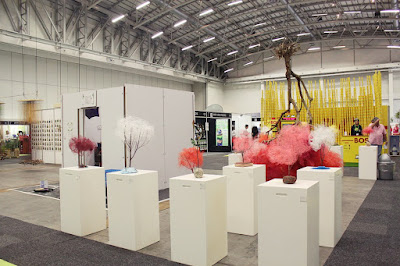


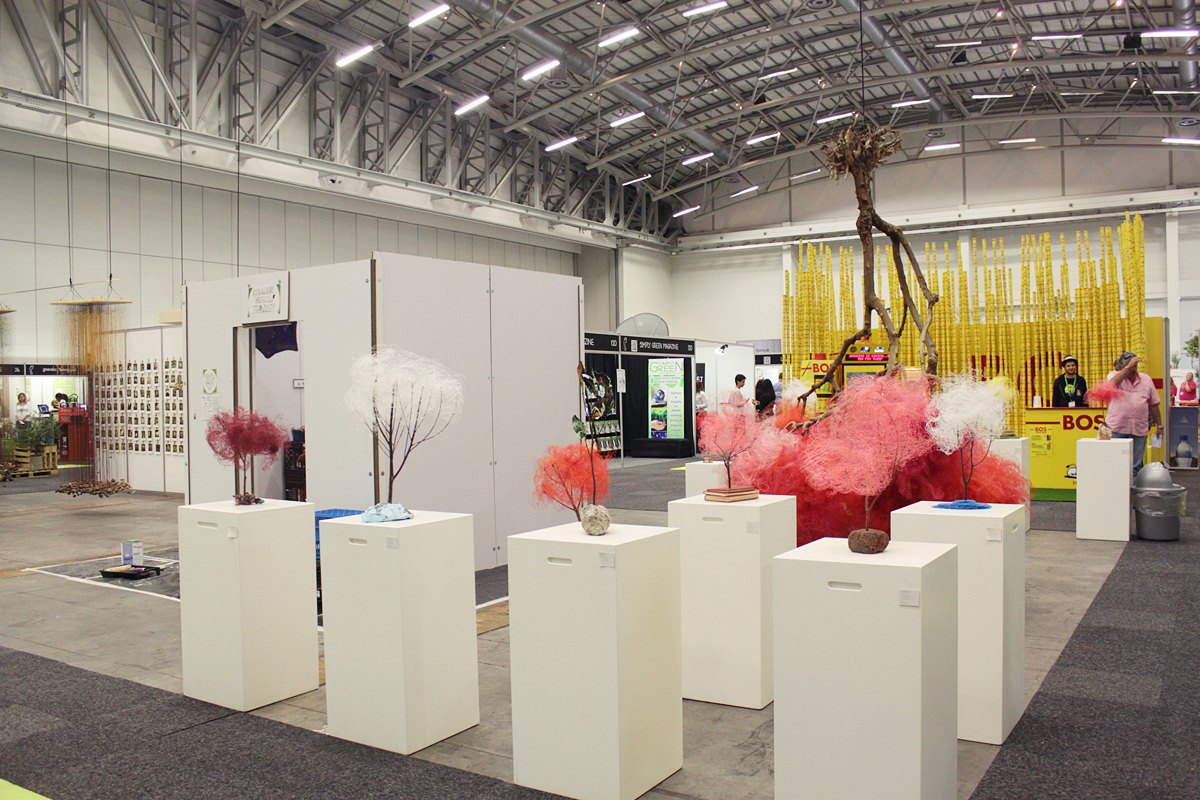
Janet Ranson's Upset Tree and Avenue of Trees are dramatic assemblages of found timber and reclaimed nylon packaging material as a simple metaphor for humankind’s devastation of the natural order.


The Collage Mural Project is an interactive piece conceived and facilitated by Claire Homewood. Expo visitors were invited to create collages around the theme of (Eco)nversations. Artists used these collages as inspiration for collaborative mural painting


STEFANIE SCHOEMAN is particularly inspired by desert landscapes and, while spending the last year between the Karoo and Namibia, she has recognised these quiet open spaces as the current theme in her work.

 |
| Simon Max Bannister's Fragments of Paradise is a series of eroded plastic flotsam that were caught as samples in the middle of the Atlantic gyre |
This exhibition was made possible by collaboration between the artists, the Green Expo organizers, the Shoprite Checkers Strokes of Genius art project, Pronature Paints and Xanita. The exhibition is hosted, sponsored and in partnership with the Green Expo in association with National Geographic Channel 281, organized by Three City Events. The exhibition aims to become an integral part of the Green Expo in the future of this annual event.
www.greenart.artlovenature.co.za
www.thegreenexpo.co.za
Tuesday, November 13, 2012
Engage & join the conversation!

During the 2012 Cape Town Green Expo in association with National Geographic Channel 281, 8 artists are exhibiting artworks and art installations that engage the viewer about our planet, seeking to spark dialogues about our connection and relationship with our natural environment.
Eight Artists, One Planet
Each artwork in some way talks to and about: nature, the earth, the natural world, the planet, the ecosystem, the biosphere, our natural heritage - and our place within it.
ARTISTS:
Simon Max Bannister, Janet Ranson, Kai Lossgott, Stefanie Schoeman, Janet Botes, Danelle Malan, Nicolle Marais, Claire Homewood
The Collage Mural Project, facilitated by Claire Homewood, forms an integral part of the exhibition. Here's the event page for it: https://www.facebook.com/events/550323068328061/
Make sure to read Recession aesthetics and making art without destroying the planet: "A Green Art Manifesto", Kai Lossgott's contribution to (eco)nversations, and part of our catalogue which is available at the exhibition: http://kailossgott.blogspot.com/2012/11/a-green-art-manifesto.html
www.greenart.artlovenature.co.za
Facebook Event page
THANK YOU to our hosts and sponsors:
The Green Expo in association with National Geographic Channel 281
The Shoprite Checkers Development Trust
Pronature Paints
Xanita
Sustainable design prototypes from the Fresh Talent competition exhibited at The Hub, Johannesburg
[Issued by MANGO-OMC on behalf of Shift]
Prototypes of the winning designs of the 2011-2012 Fresh Talent competition, hosted by the then known Eco Design Initiative (which in August rebranded to Shift: Inspiring sustainable design) will be on show at The Hub in Johannesburg from 14 November. The exhibition marks the final leg of the past year’s competition and coincides with Global Entrepreneurship week, an international initiative that introduces the act and art of entrepreneurship to young people in various countries.
The exhibition will run from 14-24 November and entry is free.
Says Janine Johnston, CEO of Shift:
“We are very excited to launch the Johannesburg exhibition of the 2011-2012 competition on this date as one of our aims is to not only teach young creatives to design sustainably but also to think in an entrepreneurial way when designing. After all, sustainable design aims to deliver social, environmental and economic benefits.”
The annual Fresh Talent competition invites young people to design sustainable solutions for a range of challenges faced by people and the environment. Showcasing the designs and concept prototypes of the 2011-2012 winners and multi-media stories of the finalists’ journey into sustainable design through their participation in Shift’s educational exchange program, the exhibition also offers the opportunity to view global examples of sustainable design curated with INDEX: Design to Improve Life®.
The winners of the 2011-2012 Fresh Talent Competition are:
Gabriele Birkenmayer for Shoots –A Grassroots Bamboo Project (first place)

Shoots – a grassroots bamboo project
“Shoots” is a full-cycle approach to sustainability that produces well-designed, good quality consumer products, furniture in particular, while addressing unemployment in South Africa and caring for the environment.
Shoots aims to involve rural communities in the planting and farming of bamboo in areas that require rehabilitation, such as those affected by soil erosion or water pollution. Bamboo is known to enrich and stabilise soil due to its root system that soaks up heavy metals and aids in water purification. Bamboo is also a highly sustainable plant, reaching maturity in 5 – 6 years and since it is a grass and not a tree, harvesting bamboo does not kill the plant. A bamboo ‘clump’ can be selectively harvested annually for over 100 years. Bamboo also produces up to 30% more oxygen than any other tree, making it not only a sustainable material, but also very environmentally friendly.
The rural communities responsible for growing these ‘plantations’ will be trained in harvesting the plants, converting it into laminated or strand woven boards and how to convert these boards into self-assemble furniture which will ‘last a lifetime’ – in terms of both material durability and non-conformity to any fashion trends.
Wayde Dyers for his Vermiculture Growth System (second place)

Vermiculture Growth System
The Vermiculture Growth System is a compact composting and rain harvesting system utilizes the benefits of worms – nature’s own recyclers, to convert food waste into nutrient rich, 100% organic fertilizer while harnessing the benefits of rain water to feed plants in home, vegetable and potted gardens.
The Vermiculture Growth System is easy to use and versatile. The unit, which is compact enough to fit on a balcony, in a shed or shaded outdoor location, is made from 70% recycled plastic.
The Vermiculture Growth System consists of five trays and a water catchment. The composting worms, Red Wigglers, start off in the first working tray and they simply eat their way up, “wriggling” into the working trays above, where they can detect the food scraps. Along the way, the worms produce castings (manure) - also known as “black gold”; trays of which can be removed, diluted and hydrated using the water collected in the system’s rain harvester for plant nourishment.
The cycle is never ending.
Marieke Adams for the Ikghuphu Sleeve (third place)

Ikghuphu Sleeve
Ikghuphu is a series of laptop sleeves made from wet suite factory waste. It draws inspiration from the Ndebele’s abstract patterns decorating clay walls, translating the colours and patterns into a multi-dimensional textile that provides tactile interest and additional protective cushioning for the product inside.
Made using neoprene offcuts –factory waste, and traditional hand crafting techniques this design combines influences of traditional and contemporary homes, in both function and material.
The traditional stitch and craft techniques used in the production of Ikghuphu Sleeves create more opportunities for skills development, job creation and economic empowerment, especially for women. Using “waste” materials reduces the environmental impact and significantly reduces the material costs of production.
The Ikghuphu Sleeve is a sustainable design that appeals to the global contemporary market of laptop users and improves opportunities for sustainable development.
The Exhibition is free and open daily from 9am to 9pm at The Hub, 4 De Beer St (cnr Smit St), Braamfontein, Johannesburg, 2000.
For more information visit www.theshift.org.za, or email info@theshift.org.za or watch the latest videos on http://vimeo.com/theshift.
Subscribe to:
Posts (Atom)