Showing posts with label product. Show all posts

Friday, May 2, 2014

The Windpump that Teaches Us Innovation


Today was one of those days where innovation, creativeness and uniqueness were everywhere to be found, even in the living room. When looking around us, we can often find artwork everywhere. Nature is in itself an artwork, but there are also the manmade artworks. Some of these manmade artworks have a way to surprise people with how simple the idea is, how little things it takes to make and how impressive the outcome is.

Many people are creative, but many people just keep it to their own websites or homes. Yet there are those who take their talent to the streets. When driving around Johannesburg, we often find highly talented dancers, mime artists and others with rather unique talents. Innovative art can also be found in Hartebeespoort Dam, on the way there and within it at the well-visited Chameleon Village. And then.... there are those artists who dwell in the 'other' nearby towns - Parys, Sasolburg, Vaalpark and Vanderbijlpark. These towns hold unique places, events and artwork. It was in Vanderbijlpark that I found a specific little gem of inspiring innovation.

A particular man was selling a 'windpomp'; an object of admiration for several people who were taking it apart to see how he managed to create it. The main parts of the pump were simply crafted from a tin. The rest was skilfully done with strong, thick wire. The bird that is so happily sitting in front of the tap, waiting for its water, was craftily made from a fallen conifer cone (better known as a pine cone). This is an artwork that took a lot of skill and time, but little resources.


There are plenty of tins lying around and many of nature’s own little pieces, which make this a financially practical and environmentally friendly artwork. It's impossible not to have respect for the way struggling or less fortunate people can often come up with the most innovative and unique ideas. We can all learn from their resourcefulness and about how not to waste, rather using and re-using what is available to us at the time. They don’t run to the shops the moment they don’t have canvas, they create their own canvas with what they see around them.

Look for your next artwork around your house, around your street and in your dustbin. You might find your light-bulb moment in something as simple as a dirty tin and some wire. This can be considered as proof that you can never say you’re too poor to make art. Art is inventing, art is seeing potential even in unlikely places.


Further browsing - some more links for Art from Waste:


Wednesday, March 19, 2014

Better Living Challenge


Have an idea that relates to access to electricity, water and sanitation, water/flood-proofing, fireproofing, ventilation, heating, cooling, space constraints, safety or privacy? The Better Living Challenge is a call to designers and innovators; manufacturers and retailers; students and professionals; self-taught designers and tradesmen; architects and engineers; to develop home improvement solutions that support a better quality of life for all.

The continually growing need for homes outstrips the capacity and resources of the government to deliver. There is a need to find home improvement solutions that are affordable and allow people to incrementally improve their dwellings at their own pace. Such solutions will contribute towards improved living conditions and quality of life. The Better Living Challenge has three entry categories.

STRUCTURAL HOME
  • Innovative products and materials used in the construction of homes.
  • Innovative approaches and components for self-built homes and structures.
  • Systems and products that allow for incremental expansion of existing structures.

COMFORTABLE HOME
  • Products, services and systems which create a more liveable and enjoyable internal environment, including improved temperature control and internal air quality, as well as light, energy and water efficiency.
  • Products and systems that address fire risk.
  • Modular and space saving furniture and storage ideas.
  • Solutions to create flexible public/private space for homes where a single space may have multiple uses throughout the day.

CONNECTED HOME
  • Products, services or systems that digitally and physically connect a home to its surroundings and beyond.
  • Solutions that connect a home to the physical environment, including food production and waste water systems.
  • Off-grid solutions for individual households.

VERY IMPORTANT:
  • You need to show you have considered the environmental impact of your products, and explored environmentally-friendly materials and efficient production techniques.
  • Solutions need to be financially accessible to the low-income market. You need to demonstrate how scale, production and material costs impact on price, and show you have thought about how to get your product, system or service to market in an affordable manner.
  • A sustainable business model will touch on how your solution can be replicated at a local level. What can be done to enhance what is already produced locally? Has thought been given to working with existing low-income housing providers?


ENTER your product or idea at betterlivingchallenge.co.za


Wednesday, February 6, 2013

Stone Paper - is the writing on the wall?

ZHANG JIANJUN

Existence Series, 1989

Acrylic, Chinese ink, Xuan paper, wood, stone, paper mache on canvas 
84 × 75 × 8 cm


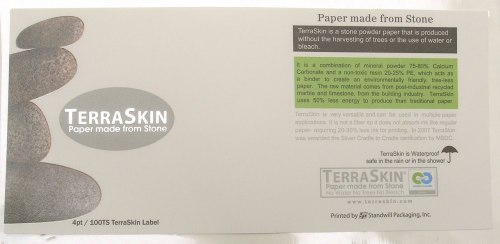
“stone papers” contain 80% Calcium Carbonate (basically pulverized marble or limestone) and 20% High Density Polyethylene (HDPE—the same plastic that’s used in milk jugs and plastic bags).


Source: Tumblr

While there's not yet a lot of reviews about the paper, and whether it's really as environmentally friendly as it claims to be, it seems to be a good option when you look at the water consumption and energy savings in its production. They are said to use no water, no toxic chemical bleaches and use far less energy.  They are recyclable as well. (Read more)


From the Sketchy Musings Blog


I have also read that the paper is made from the waste product in quarries from the building and construction industry. If this is the case, and if the sludge from mining dumps could also be used, then this paper has my vote.

Read up, find out and speak up! What do you think - is this tree free paper a wonderful new innovation or just another gimmick tapping into a green consumerism market? Leave a comment, or email your thoughts to artlovenature@gmail.com


Source