Showing posts with label environmental justice. Show all posts

Thursday, July 24, 2014

Fear&Loss - Industrial Karoo group exhibition


This is the dead land
This is cactus land
Here the stone images
Are raised, here they receive
The supplication of a dead man’s hand
Under the twinkle of a fading star.
Is it like this
In death’s other kingdom
Waking alone
At the hour when we are
Trembling with tenderness
Lips that would kiss
Form prayers to broken stone.
- From The Hollow Men, T.S. Eliot 1925

A word by the curator

The installation Fear&Loss speaks of the possible environmental damage should the Dutch oil giant Shell be granted an exploration license to drill for shale gas in the Groot Karoo – the place of my home, community and livelihood.  
Fracking - or hydraulic fracturing - involves pumping toxic chemicals and fluids under high pressure five km deep into the earth’s core. This causes the seams in the layers of sediment to break apart for gas and oil extraction. Large volumes of water are needed for this and these fluids and chemicals cannot be recycled and remain in the earth, causing the fear of contamination of the underground water supply. In the Karoo, this is drawn from its reservoir of interconnected aquifers through the use of boreholes and springs (http://www.greenpeace.
org). 
My work has evolved out of my own deep concern and passion for this widely-ignored part of our country. Despite larger questions that arise, the work is also intensely personal since it addresses a situation that will impact dramatically on me, my family, and community. As such, my intention is that the work may raise awareness in its creation of a specific and intimate
installation space. 
Fear and Loss focuses on the impact of global capitalism and consumerism on individuals and small communities. Eliot’s poem, The Waste Land (1922) reveals the emotional and physical scars and damage left by World War I and expresses the unspoken wish that this type of tragedy will not be repeated. But Fear&Loss represents the probability that man-made disasters will. Creative works, such as the poem The Waste Land, or the visual art installation Fear&Loss, remain tools for communication, to reach out beyond our immediate realm of understanding and lay bare our hope for humanity.

- Katie Barnard du Toit 
 

Wednesday, February 26, 2014

2014 Cape Town Eco Film Festival


5 DAYS, 10 SA PREMIERES, 25 ECO FILMS!


www.capetownecofilmfestival.com


DO NOT MISS the inaugural Cape Town Eco Film Festival, which will take place at the Labia Theatre on Orange Street in Cape Town from Thursday the 27th of March to Monday the 31st of March

We’ve got so many brilliant environmental documentaries to share with Capetonians, we’ve had to extend the length of the Festival by a day. The Festival will now run from the 27th until the 31st of March, instead of the 30th as initially planned”. 
- Dougie Dudgeon. 

Among the 25 short and feature-length films to be on show, are 10 movies that have never been seen in South Africa. 

We’ve really got something for everyoneWhether you’re interested in fracking or industrial hemp production, genetic engineering or climate change, the fate of the world’s bees or organic food – we’ve got a documentary film for you!” 
- Andreas Wilson-Späth

The highlights of the lineup include:

  • Gasland Part II – the explosive follow-up to the 2011 Oscar-nominated film Gasland about fracking.
  • Blackfish – an astonishing eco-thriller about the plight of killer whales in captivity and the danger that comes with it.
  • Bringing It Home – a film about industrial hemp cultivation featuring Cape Town’s own hemp expert Tony Budden of Hemporium fame.
  • More Than Honey – a beautiful Swiss masterpiece that compares old-fashioned beekeeping with its modern industrial counterpart.


The complete programme and information about all of the films, including trailers, can be found on the Festival website: www.capetownecofilmfestival.com.

Tickets will sell for R45, of which R5 will go towards Festival sponsor Greenpop’s tree planting efforts. “Festival goers will also be able to buy ‘Tree Tickets’, which will cost R160 and each of which will allow Greenpop to plant a tree!” explains Wilson-Späth.

Online ticket sales will become available on the Festival website within the next few weeks.
For now, tickets may be reserved by calling the Labia box office at 021 424 5927.

The Cape Town Eco Film Festival is a project of While You Were Sleeping, a non-profit organization dedicated to bringing documentary films with important environmental, social and political messages to South African audiences.

The Festival is made possible through generous contributions from sponsors Reliance Compost, JoJo Tanks, Hemporium, Ballo and Earthbound wines, and is hosted in partnership with Greenpop, Exploring Consciousness, Simply Green, Green Times, Project 90 By 2030, Bicycle Cape Town, Bellovista Productions, Janet Botes, Coz it Counts and the Charter for Compassion.

For more information, visit www.capetownecofilmfestival.com and www.facebook.com/whileyouweresleepingSA and follow While You Were Sleeping on Twitter (@WYWS_SA).


Wednesday, September 25, 2013

Earthlife Africa Press Release: The climate circus is in town!

An international conference concerned with clean air, the International Union of Air Pollution Prevention Association’s (IUAPPA) “Clean Air Congress” in Cape Town at the end of September, is being sponsored by some of South Africa’s biggest air polluters.

Sasol (which is the emitter of the largest point source of climate changing greenhouse changing gases in the world); Eskom (who are currently requesting an exemption from compliance with South Africa’s National Air Quality Act and supporting plans to build yet a third mega-coal fired power station, notwithstanding radioactive emissions from its Koeberg nuclear power plant); Engen (with a long history of harm to residents of South Durban); Shell (linked to human rights and environmental violations in the Niger delta, and one of many who wish to carry out polluting hydraulic fracturing in our country) and Exarro, our 2nd largest coal mining company. We find it surprising that no mention is made of the fatally toxic and radioactive air pollution planned by the smelter plants of the South African Nuclear Energy Corporation (Necsa) at Pelindaba.

“The Clean Air Congress is shown for what it is – an opportunity for South Africa’s Climate Clowns to sponsor a green-washing circus” said Muna Lakhani of Earthlife Africa Cape Town. “The irony is compounded by the fact that the Mayor of Cape Town and the MEC for the Western Cape (who are featured speakers at the Congress) support this process.”

Over 60 civil society organisations find this Congress problematic. An indication of the potential for “green-wash” can be found in the draft programme (fourth revision), which has as a heading “Health Impacts and Perceptions.”
“The health impacts of air pollution are not ‘perceptions’, they are a fact!” commented Des D’sa of the South Durban Community Environmental Alliance (SDCEA). “Our children and other residents suffer from high rates of upper respiratory tract problems due to poor air quality in South Durban.” 

They are calling for companies to take responsibility for their actions, and for government to hold them accountable, in a transparent manner.

Roegshanda Pascoe, of the Manenberg development co-ordinating structure, says “Our people are hurting with the high and rising electricity prices, and with nuclear and more coal power stations, prices will just keep on escalating. Since the first price increases, we have seen an increase in domestic violence linked to unaffordability of electricity, and other social impacts. It is time government takes the steps necessary to change our vision to one of energy security for all, in a safe and sustainable way.”

Community members feel that government must take their lead from our Constitution, and fully engage civil society in our supposed “participative democracy” in fully informed and thorough consultation before taking decisions on behalf of communities, especially the poor.

The media is encouraged to cover this congress, and ask the questions that civil society are asking, viz:

  1. Why is a parastatal even asking for an exemption from our National Air Quality Act, when a substantial body of evidence confirms harm from coal fired power stations?
  2. Why is fracking even being considered, when it is at least as problematic as coal, certainly from a climate change perspective? Has nothing been learnt from water, land and air pollution impacts elsewhere in the world, accompanied by social devastation?
  3. Why is government complicit in these kinds of “greenwashing” exercises, yet finds it impossible to hold companies to account for the known harm that they do?
  4. What is the point of IUAPPA convening such a congress under these auspices, when even they (IUAPPA) confirm: “Air pollution causes over 800,000 deaths and tens of millions of respiratory and other illnesses each year. It damages ecosystems and affects quality of life, reduces economic activity and reinforces the cycle of poverty in many areas of the world.”

Civil society that is concerned with plans for more climate change-inducing coal fired power stations that is now on the cards in South Africa, dangerous and expensive nuclear power, polluting and socially and environmentally devastating hydraulic fracturing (fracking), problematic coal mines and the high price of electricity, have come together to protest this gathering of our polluters and government representatives.

The protest is planned for Sunday the 29th of September between 2pm and 4pm opposite the Cape Town International Convention Centre. Cape Town Mayor, Councillor Patricia de Lille, and representatives from the named polluting companies have been invited to receive a memorandum outlining the concerns of civil society that believe the polluter-pays-principle should be strictly enforced. This initiative has thus far received the support of more than 80 organisations.

Come and join us!!


This initiative is supported by:

Earthlife Africa Cape Town; CAPTRUST; Community Consent Movement; Manenberg Dev Co-ord Structure; Southern Cape Land Committee, Groundwork, South Durban Community Environmental Alliance,  Cochoqua Tribal House (Khoi San), Coalition for Environmental Justice, Million Climate Jobs Campaign, The South African United National Anti-nuclear Mobilisation Initiative (TSUNAMI) comprising over 60 organisations; Coalition Against Nuclear Energy (CANE) comprising numerous community-based organisations, professionals and NGOs.

Thursday, April 25, 2013

THE GUN & THE PEN by Stan Aneto


THE GUN & THE PEN – Stan Aneto 2013

My gun's got loaded 
my pen on the white paper of tears
should I be more concerned 
about animals and plants 
than humanity on a final push of extinction...?
They call me the earthman
Coined from an untamed affair with nature
an unscripted romance ordained by divinity
Long before my placenta was trimmed
it is a sacred calling to curate and caress
but should I be more concerned
about plants and animals
than humanity on a final push of extinction...?
The mind of poetry is insatiable
Bottomless like the pit of hell
Cos the issues on my table are endless
I am much worried about the shedding of blood
As I am worried about frequent flood
I am much worried about genocide
As I am worried about ecocide
I am much worried about nuclear warning
As I am worried about global warming
I am as much worried about mindless shelling
As I am worried about senseless tree felling
I am much worried about human rights
As I am worried about animal rights 
I am much worried about corruption
As I am worried about pollution
For I see the inordinate pursuit of riches
Increasing the scale of endangered species
The mind of poetry is insatiable
Bottomless like the pit of hell
So I bless my pen and paper

Monday, March 18, 2013

Artist Feature: Imke Rust

Keep an eye open for work by Imke Rust, who is making waves... Her work casts a critical eye on the controversial mining and industrial developments on the Namibian coast, and her exhibition showing this work has been rejected by the Swakopmund Arts Association due to it being labeled as "an irrelevant and scientifically dubious campaign against the economically important uranium mining in Namibia".  Rust works in a variety of mediums and techniques to express her views and raise awareness towards the concerns and feelings of the community. Find out more on her website: imkerust.com.


Dorob (NOT) 4Sale 2013

Temporary installation of 15 signs at 5 different locations along 
the C34 road in the Dorob National Park, Namibia.
Dimensions of Signs: 60 x 80cm
Correx Board, digital prints, spray paint, iron poles & cable binders
11 – 29 January 2013
Permanent webpage:  www.dorob4sale.wordpress.com and 
life cellular phone number with prerecorded answering message.


 Subrosa 2012
Temporary Installation of 99 black roses in the Namib Desert

22° 43’ 01” S – 14° 33’ 47” E,  April 2012
Original Dimensions: 90 x 270 x270cm
Black rubbish bags, barbed wire, wire


Tokoloshe Trap 2012

Temporary installation of 1521 white thorn pairs from the Acacia Karroo tree arranged into 39 circles in a side tributary of the Swakop river bed, Namib Desert.

22° 38’ 10” S – 14° 43’ 40” E, April 2012
Original dimensions: 5 x 600 x 250 cm
Medium: Acacia thorns

Tuesday, February 12, 2013

Bodo City, by Stan Aneto


"The people of bodo, a community in Ogoni Land of Niger Delta Nigeria, have been on the spotlight of many environmental discourse. I found out why, when I paid a visit myself. My findings were politically sensitive and emotional. As a poet and film maker, it was only natural for me to create this piece, hoping they eventually find the justice and ultimately, the world that once belonged to them." - Stan Aneto

Stan Aneto is a pro environmental artist, film maker, poet and performer currently residing in Cape Town. Over the years, his passion for nature and the environment has inspired songs, poems, and also visual arts. 'TRAUMATA OF THE EARTH QUEEN' is a theatre work of 1 hour, consisting of poetry, dance, music, photography and fashion on one stage. It tells a story of our beautiful planet, a queen, as she goes through a terrible time of abuse from her subjects. View the 15 minute pilot of Traumata of the Earth Queen on Youtube

He is interested in getting involved or collaborating with an organization. If interested, contact him at:
STAN ANETO | cell: 078 622 4832 | e: stananeto@hotmail.com | twtr: @stananeto
 

Wednesday, January 30, 2013

"Imagine the Unthinkable" installation by Strijdom van der Merwe

"Imagine the Unthinkable", Strijdom van der Merwe, Installation View, exhibited at Circa on Jellicoe, JHB. Photograph from the BEELD.

Land artist Strijdom van der Merwe created an art installation entitled "Imagine the Unthinkable" as part of his exhibition 'Drawing clouds in the Karoo' at Circa on Jellicoe, Johannesburg. The installation comments and expresses the effects or nature of fracking, or hydraulic fracturing, planned for the arid and beautiful Karoo basin. Fracking entails drilling into the earth, and extracting natural gas from the shale layers by flushing a cocktail of chemicals and water down the shaft and into the rock layers to fracture the shale and release the gas captured in these layers. Strijdom's work makes use of maps of the actual sites for which drilling and fracking is planned, and uses sound as a device to accentuate the unnatural and disturbing nature of the process.

As with most industrial and mining processes, there is a lot of money to be made, and the companies who benefit from this have no qualms in doing what is needed to stake their claim and make their profits. At the cost of the environment, and the local people who need to live with the consequences - in this case the very high risk of contaminated ground water and reduced air quality caused by toxic pollution (particularly from the spent fracking fluid 'dams' and from cracks in the drilling shaft).

Van der Merwe does not perceive himself as a protest artist. His work usually rather enhances or encouarges an appreciation for nature's beauty. He aims to strengthen or accentuate the landscape's inherent beauty, and through this sometimes make people more aware about desertification, global warming and nature conservation. He often works in the Karoo, and therefore the risks or threat that fracking poses are a very real and personal matter.


Read more about the art installation:


Read more about fracking in the Karoo:

Monday, May 16, 2011

Celebrate Biodiversity!

22 May
International Day for Biological Diversity

The International Day for Biological Diversity (or World Biodiversity Day) is a UN international day for the promotion of biodiversity issues. The theme this year is Biodiversity and Forests.

More information: http://www.cbd.int/

Another date to diarize:

23 May – 01 June
Eskom: proposed nuclear power station – public meeting

Eskom is hosting a series of public meetings as part of their environmental impact assessment for a proposed nuclear power station. Please go along to make your views heard to strengthen our call for no nuclear power and a call for a renewable energy revolution.


  • 23 May: Pretorius Hall, Main Road, Gansbaai. 18h00 - 20h00

  • 25 May: Atlantic Beach, Golf Club, Melkbostrand. 18h00 - 20h00

  • 30 May: Oyster Bay Hall,Oyster Bay. 18h00 - 20h00

  • 31 May: St. Francis Links Golf Club, St. Francis Bay: 18h00 - 20h00

  • 01 June: Sea Vista Community Hall, Sea Vista, 16h30 - 18h00 Public Open Day

More information: www.eskom.co.za/eia under the “Nuclear 1-Generation” link


This information was obtained from the Project 90 by 2030 April newsletter. Visit their website at http://www.90x2030.org.za/

Anti-fracking Activists call for a National Boycott of Shell


An excerpt from the press release issued by Earthlife Africa Cape Town:


Earthlife Africa is calling for a nationwide boycott of all Shell service stations and all Shell products, from Tuesday 17th May – which coincides with Royal Dutch Shell’s AGM in the Netherlands, and is also, co-incidentally, the United Nation’s World Information Society Day - to show their displeasure at plans to “frack” large parts of our country.

“We ask people to go to their nearest Shell garage, NOT fill up, but ask to speak to the manager and say that they have nothing against the manager personally, but the company is carrying out plans that have potentially horrendous impacts on people and especially scarce water in our country,” said Andreas Spath, Earthlife’s
Anti-fracking co-ordinator.

Shell, the South African government and the natural gas industry portray shale gas as a climate-friendly, low-carbon energy source. In reality, however, preliminary studies have shown that if the entire carbon footprint, including methane (a much more potent greenhouse gas than CO2) escaping from fracking wells in substantial quantities, is taken into account, natural gas from this source contributes to climate change in a magnitude similar to oil and coal.

“Shell’s record in Africa should be cause for alarm”, said the Reverend Barry Wuganaale, of the Ogoni Solidarity Forum. “Not only for widespread and continuing environmental harm, but they have also acknowledged being complicit in the murder of activists opposing them in Nigeria. They cannot be trusted.”

Read the full press release here: http://www.earthlife.org.za/?p=1591


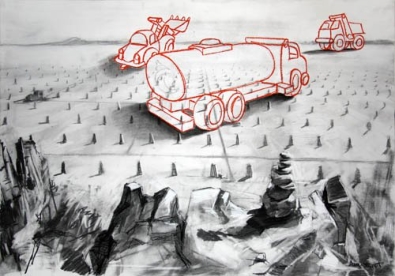
VALLEY OF DELINQUENCY, charcoal and pastel on paper.
Duncan Stewart
[
See more of his work]

Saturday, May 14, 2011

GREEN DRINKS Cape Town

GREEN DRINKS CAPE TOWN


DATE & TIME: Monday 16th May 2011, 18h30 onwards (Talks at 19.00pm)
VENUE: The Josephine Mill, Newlands, Cape Town
BRING: An open mind, a good attitude, some friends
JOIN: email greendrinks@josephinemill.co.za


The energy story will not go away. This month we are giving the floor to Earthlife to hear their strong convictions against the continuation and development of Nuclear Power. This is topical for South Africa as we approach the finalisation of an Environmental Impact study relating to a proposed new nuclear facility near Cape St. Francis. (The direct cost of the Japanese Nuclear calamity is estimated at $100billion.)

The Fukushima Nuclear Disaster - 25 years after Chernobyl. What do we know about Fukushima and what does it mean for South Africa?

Gray Maguire has been involved in socio-environmental justice causes since 2003 when he was working in Tanzania. He subsequently did a degree in development studies while still working in much of the rest of Southern Africa and later did a six month hitch-hiking expedition through 14 countries investigating community based development strategies. He started an environmental management consultancy called Green Earth Consulting in 2008 as well as a Public Benefit Organisation called the Nomad African Trust. He’s presently in the middle of a post graduate degree in environmental management and while being a freelance sustainability consultant also serves as branch secretary for Earthlife Africa Cape Town.

EarthlifeAfrica is an environmental and social justice NGO that has been active on these kinds of issues since the 80's. We have been standing in opposition to governments nuclear ambitions for most of that time and were successful in our campaign to stop the Pebble-bed modular reactor.


If you too would like to share your dreams or what you do, please let us know (greendrinks@josephinemill.co.za). Make a presentation in the future…. and become a part of a growing, conscious–living community. Share knowledge, wisdom, skills, hope, and enthusiasm.


Further details
: www.josephinemill.co.za/greendrinks.html


This post was created by using the Green Drinks Cape Town email newsletter/notification. All content have been created by the Green Drinks team.

Friday, April 15, 2011

25th Anniversary of the Chernobyl Nuclear disaster

Illustration: Matt Davidson

Illustration: Matt Davidson
Found here (read more about nuclear in Australia)


MEDIA RELEASE: 25th Anniversary of the Chernobyl Nuclear disaster

A Salute to Radiation workers everywhere. - Japanese Consul to receive
messages of condolence and concern from local anti-nuclear groups.

The ongoing disaster at the Fukushima Daiichi plant could not have come at a
more poignant moment. While the world's attention is focused on this
unfolding catastrophe we must remember to contextualise current events in
light of the past. The 26th of April, 46 days after the start of the ongoing
Fukushima nuclear crises, marks the 25th year after at similar disaster in
Chernobyl, Ukraine. How tragic to witness, 25 years on, a repeat of the
desperation that drives men and women into a working environment that they
know will kill them, with Chernobyl now being assessed as being responsible
for nearly a million deaths, and with the total fuel at Fukushima many times
that of Chernobyl. 1,760 tons of nuclear fuel versus just 180 tons at
Chernobyl, implying a potential impact some 10 times greater from the
current disaster is, but which is becoming more difficult to quantify as the
Fukushima accident is already ranked as a level 7 disaster which is where
the scale for such events ends.

Our hearts must go out to the "Fukushima 50". Four teams of 50 brave workers
who, on a daily basis, expose themselves to massive quantities of radiation
to help avert a total meltdown. Instead of learning lessons from the
Japanese experience before we aggressively pursue more nuclear options in
South Africa, government approved the Integrated Resource Plan (IRP2) (that
will make nuclear power the single biggest contributor of new future
capacity to our national grid), within the first week of the Fukushima
disaster. This, when almost every other country with new nuclear build plans
are taking a step back, and indeed, reducing and cancelling such plans, as
in China and Germany.

"South Africa has an array of alternative, renewable energy supplies that
are cheaper, create more jobs, contribute less to climate change and don't
leave us with a multi-100,000 year waste legacy, said Muna Lakhani,
Earthlife Africa's Cape Town anti-nuclear spokesperson. "It is time that we
reawaken the spirit of the Struggle and remind ourselves that we do have the
power to shape our future."

"Around Fukushima Daiichi Station, on March 23rd, they measured 400
millisieverts - that's per hour. With this measurement (Chief Cabinet
Secretary) Edano admitted for the first time that there was a danger to
health, but he didn't explain what this means. All of the information media
are at fault here I think. They are saying stupid things like, why, we are
exposed to radiation all the time in our daily life, we get radiation from
outer space. But that's one millisievert per year. A year has 365 days, a
day has 24 hours; multiply 365 by 24, you get 8760. Multiply the 400
millisieverts by that, you get 3,500,000 the normal dose. You call that
safe? And what media have reported this? None. They compare it to a CT
scan, which is over in an instant; that has nothing to do with it," said
Hirose Takashi, well known author on the nuclear industry.

Independent scientists are warning, contrary to statements from the talking
heads on corporate media outlets who say Japan is not Chernobyl, that the
levels of radioactive material being released in from Japan's nuclear
fallout already rivals Chernobyl levels as at the end of March.


In a more local vein, Earthlife Africa's Cape Town branch secretary, Gray
Maguire, said: "Six months after 90 Koeberg workers were contaminated by
radioactive Cobolt-51, our leaders have yet to announce the names of the
members of the panel of inquiry supposedly convened to look into the
accident. What confidence do we have that even the current problems can be
resolved, far less the imposition of even more nuclear radiation, when the
alternatives are cheaper and create more decent work for our people?"

To this end, members of the media and of the public are invited to a number
of events in the run up to Chernobyl Day (26th April). Earthlife Africa Cape
Town will be hosting a number of events to raise awareness about the
outcomes of our recently approved IRP2; information linked to the global and
local nuclear industry and a way forward.

* 18th April - Monday (12:00pm to 14:00pm - Pier Square, Heerengracht Street, Cape Town, with handover at 1:00pm). - A demonstration of concern about the events at Fukushima, a commemoration of the legacy of Chernobyl, a protest against the IRP2 and the submission of statement of solidarity, of condolence and concern, to the Japanese Consul in sympathy with their plight. Activities include an art installation, music and related activities.

* 21th April - Thursday ( 12:45pm to 14:00pm at 6 Spin Street Cape
Town) "Investigating South Africa's nuclear goals" - by Gray Maguire -
Earthlife Africa Branch Secretary.

* 21st April - Thursday (6:15pm at the Labia on Orange) Screening of
the documentary "The Nuclear Comeback" with a facilitated discussion
afterwards.


This media release was written and issued by Earthlife Africa Cape Town:
Contact:
Muna Lakhani - 083-471-7276 or muna@iafrica.com
Gray Maguire - 084-3355778 or graymaguire@gmail.com